What role does inland waterway transport play in Europe today, and what does the Seine–Scheldt network represent for economic stakeholders?
Inland waterway transport plays a role that is both discreet and essential. Discreet, because it remains largely out of sight in public debate, yet essential for many industrial activities. Beyond a certain volume of goods, the waterway becomes a decisive logistical tool for the competitiveness of industrial sites and ports.
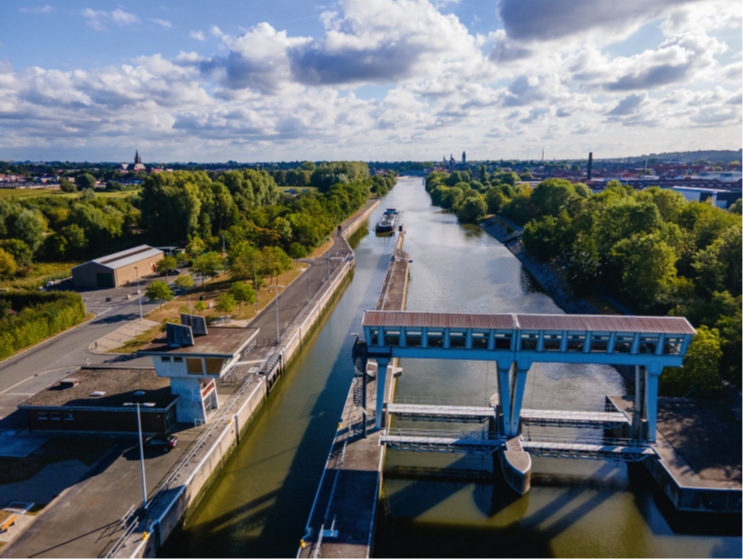
In this context, the Seine–Scheldt network is clearly aligned with a European approach. Its goal is to connect major industrial and port basins, ensuring continuity for large-gauge navigation between the Benelux and the Seine Basin. This type of infrastructure goes beyond local concerns; these are structuring investments, whose impacts are often measured over several decades.
What main challenges are users of the inland waterway network currently facing?
One major challenge concerns the performance of existing infrastructures, and their maintenance in particular. Building a facility is a significant step, but maintaining a consistently high level of service is equally essential for users, who require reliability and predictability.
The energy transition of the sector is another challenge. Decarbonisation will undoubtedly involve several complementary solutions, including the use of biofuels, the rollout of electrification, and the installation of associated facilities, such as charging points. These developments are already under way, but require sustained investment and long-term support.
What expectations do industrial stakeholders and ports have of major networks such as Seine–Scheldt?
Expectations primarily concern the ability to provide efficient and continuous infrastructures, enabling the transport of large volumes over long distances. A link such as Seine–Scheldt opens up new prospects for modal shift and the organisation of multimodal logistics chains.
There is also a challenge in terms of project visibility and understanding. For certain economic stakeholders, the commissioning horizon may still seem distant, which makes it necessary to undertake information and awareness-raising efforts. The ability to transport significant volumes between the major northern ports and the Paris Basin represents a clear strategic advantage on a European level.
Which developments do you consider most promising for enhancing the attractiveness of inland waterway transport?
Several innovations could gradually transform the sector. Automation and navigation assistance systems are already being developed and are expected to continue advancing in the coming years.
At the same time, the use of alternative fuels and vessel electrification, i.e., the use of boats operating wholly or partly on electricity, are key avenues for reducing the environmental footprint of inland waterway transport.
Finally, it is vital we do not overlook other aspects of inland waterway development, particularly tourism, which is seeing significant growth in Europe and also contributes to the enhancement of regions crossed by major river corridors.